
Buddhism
Buddhism arose in northern India in the fifth century BCE. Its starting point is the Four Noble Truths: an examination of suffering, its cause and a way out — not a doctrine to believe but an instruction to test.
- Your Friendly Ping
Today, 07:15
Don't read it. Just do it.
“I feel this feeling fully — then let it move on.”
Deep DiveMoreThe Buddha described the mind as a guesthouse — emotions arrive, stay for a time, and leave — and recommended neither evicting them prematurely nor offering them permanent lodging. Rumi's poem 'The Guest House' (13th century) gives this image its most beautiful formulation in Sufi poetry: 'Welcome and entertain them all! / Even if they're a crowd of sorrows, / who violently sweep your house empty of its furniture.' The neuroscientist Jill Bolte Taylor, writing after her own stroke, identified a physiological basis for this: an emotion, unless reinforced by thought, has a neurochemical lifespan of approximately 90 seconds. What keeps it alive beyond that is the story we tell about it. The feeling is not you; you are the one who noticed it arrive.
Ping done - Your Friendly Ping
Today, 09:40
Don't read it. Just do it.
“I silently wish the next person I see: may you be well.”
Deep DiveMoreMetta (Pali: loving-kindness) is the first of the four brahmaviharās — the divine abodes or immeasurable qualities of an awakened heart. Classical metta meditation moves through concentric circles: oneself, a beloved person, a neutral person, a difficult person, and finally all beings. The instruction here activates the neutral-person practice in daily life. Neuroscientific research by Richard Davidson and Barbara Fredrickson shows measurable changes in amygdala activity and vagal tone after even brief metta practice. Fredrickson's 'micro-moments of love' research demonstrates that even a momentary orientation of goodwill toward a stranger — without interaction — changes the wisher's physiological state. The wish does not require knowing the person. It requires only the orientation.
Ping done - Your Friendly Ping
Today, 12:30
Don't read it. Just do it.
“Before speaking next: I ask — is it true, and is it beneficial?”
Deep DiveMoreThe Majjhima Nikāya gives the Buddha's five criteria for Right Speech (sammā vācā): the words are spoken at the right time, they are true, they are gentle, they are beneficial, and they come from a mind of goodwill. This is not a checklist but a quality of presence before speaking. 'Is it true?' is necessary but not sufficient — harmful truths spoken at the wrong moment are still failures of Right Speech. 'Is it beneficial?' (Pali: hitāya) asks: who benefits, and how? — including the speaker, the listener, and the broader situation. The practice of asking these questions before speaking is itself a form of sammā sati (right mindfulness): a pause in which the mouth waits for clarity. Most regretted words were spoken without it.
Ping done
The second arrow stays out
The first unpleasant thing cannot be avoided. The second — anger about the anger, worry about the worry — is self-made and can be dropped.
Everything has a duration
Impermanence sounds sad and turns out to be a relief: the state you are in ends. That is not consolation but observation.
Checkable, not believed
This tradition asks you to accept nothing you have not examined yourself. That is what makes it usable for secular practitioners.
What Buddhism is
In this app Buddhism is not a religion but a psychology with practice instructions. Its starting point is a plain observation: much in life is unsatisfying, and a good share of that dissatisfaction arises not from circumstances but from how we relate to them.
Two insights carry almost all the Buddhist pings here. One is impermanence: whatever arises passes — including the state you believe you cannot bear. The other is the distinction between the pain and what we add to it. The image is two arrows: the first hits, that is life. The second we shoot ourselves.
The ways of practice
This is the one tradition here that brings its own methods rather than a single technique. Four of them appear often enough in the pings to deserve a name — not rivals, but different doors into the same room.
The Eightfold Path is the practical half of the diagnosis, and strikingly little of it is meditation: of eight limbs only three concern what we usually call practice; the rest are about seeing, intention, speech, action and livelihood. Right is an unfortunate translation — the original word means something closer to complete or fitting. And it is not a staircase: the limbs hold each other up, which is why the image is a wheel and not a ladder.
Metta is the Pali word for loving-kindness, and the practice is disarmingly simple: you silently wish someone well, in sentences. Yourself first, then someone you love, then someone you feel nothing particular about, then someone you find difficult. What matters is that it is a practice and not a feeling — nobody asks you to like anyone. The sentences are the intention; whether warmth arrives is not your job.
Vipassana means insight, more literally clear seeing: attention led systematically through the body, observing what is there and changing nothing. The core is not the observing but the not-reacting, because that makes visible what we know in theory and forget in practice — every sensation changes on its own. The itch you do not scratch fades. So does the pull to check the phone, if you simply watch it a while.
Mantra practice is the most inconspicuous: a word, a syllable or a short phrase, repeated. The inner commentary cannot be switched off, but it can be occupied — and a repeated word occupies exactly the channel it otherwise runs on. For an app like this one, that matters for a specific reason: it is one of the few concentration techniques that stays entirely invisible. Repeating a word silently works on a crowded bus.
Origins
The origin lies in north-eastern India in the fifth century BCE. The discourses were passed on orally and written down centuries later; the oldest fully preserved collection was set down in Sri Lanka in the first century BCE. The discourse that first names the Eightfold Path is held to be the earliest of all, and its form is that of a medical examination — the Indian medicine of the time used the same four-part scheme of symptom, cause, curability and treatment.
Vipassana as a distinct method is young by comparison. A renewal movement in late nineteenth- and early twentieth-century Myanmar opened the practice to lay people and cast it into clearly teachable procedures, producing two schools: one named after Mahasi Sayadaw, working with silent noting, and one going back to U Ba Khin and his student S. N. Goenka, sweeping attention through the body in fixed paths.
It reached Europe in several waves — first in the nineteenth century as an object of philological research, then from the 1960s through people who travelled to Asia and came back as teachers. The last and most consequential wave was a translation: from 1979 parts of the practice were stripped of their Buddhist terminology in a clinical programme. That became the basis of almost every mindfulness offering today — and it drew a criticism worth taking seriously, since the ethical half of the path largely fell away with it.
Key figures in the Friendly Pings
In the Buddhist pings of this app the historical Buddha does not stand alone — beside him the deep dives cite contemporary teachers, the Burmese Vipassana lineage, an emotion researcher and, remarkably, a Persian poet.
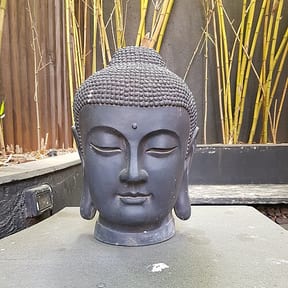
Siddhartha Gautamaetwa 5. Jahrhundert v. Chr.
Der historische Buddha. Im Satipatthana-Sutta ist die Achtsamkeitsübung erstmals systematisch beschrieben, im Achtfachen Pfad ihre Einbettung in eine Lebensführung. Beide Texte stehen hinter einem guten Teil dieser Bibliothek.
Image: Fitindia · CC BY-SA 4.0 · Wikimedia Commons
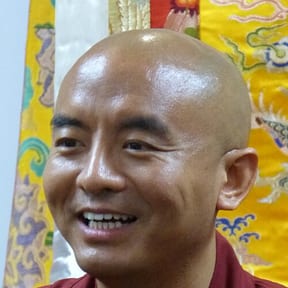
Yongey Mingyur Rinpochegeboren 1975
Tibetischer Lehrer, der offen über seine eigene Panikstörung spricht. Sein Zugang — Unruhe nicht bekämpfen, sondern sie zum Meditationsobjekt machen — steckt in mehreren Pings zu Angst und Körperwahrnehmung.
Image: Gazebo · CC BY-SA 3.0 · Wikimedia Commons
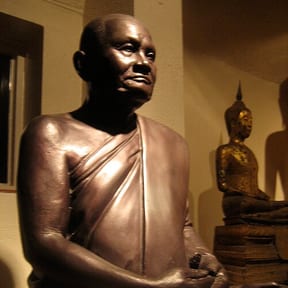
Ajahn Chah1918–1992
Thailändischer Waldmönch und Lehrer vieler westlicher Schüler. Sein Ton — trocken, bildhaft, unsentimental — hat den westlichen Theravada geprägt.
Image: Akuppa John Wigham from Newcastle upon Tyne, England · CC BY 2.0 · Wikimedia Commons
S. N. Goenka1924–2013
Verbreitete die Vipassana-Praxis in der Tradition von Ledi Sayadaw weltweit über zehntägige Schweigekurse. Seine Anweisung, Empfindungen zu beobachten ohne zu reagieren, steckt in fast jedem Vipassana-Ping.
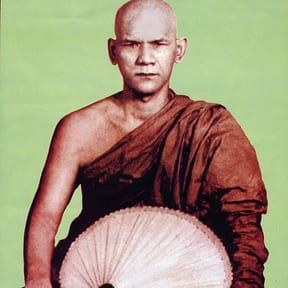
Mahasi Sayadaw1904–1982
Burmesischer Mönch, von dem die Noting-Praxis stammt: das stille Benennen dessen, was gerade auftaucht — „Hören", „Denken", „Enge". Eine der wenigen Übungen, die im Gehen funktionieren.
Image: Unknown authorUnknown author · Public domain · Wikimedia Commons
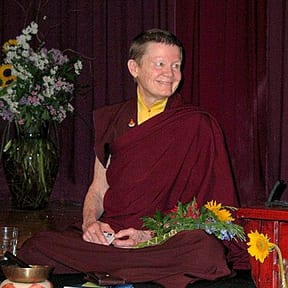
Pema Chödröngeboren 1936
Amerikanische Nonne in der tibetischen Tradition. Ihr Begriff des Bleibens im Unbehagen, statt sofort davor auszuweichen, prägt die Pings, die nicht versprechen, dass ein Gefühl gleich vorbei ist.
Image: cello8 · CC BY-SA 2.0 · Wikimedia Commons
Barbara Fredricksongeboren 1964
Zeigte 2008 mit ihrer Arbeitsgruppe, dass sieben Wochen Metta-Praxis positive Emotionen im Alltag messbar erhöhen — als bleibende Neigung, nicht als vorübergehende Stimmung.
Image: Gabriella Clare Marino · CC BY-SA 4.0 · Wikimedia Commons
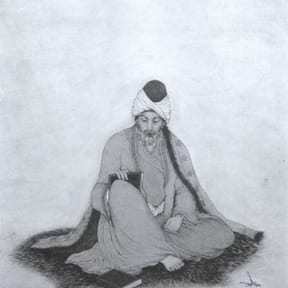
Rumi1207–1273
Persischer Dichter und Sufi. Sein Gedicht vom Gästehaus — jedes Gefühl ist ein Gast, kein Bewohner — steht wörtlich hinter einem der meistgenutzten Pings dieser Bibliothek.
Image: Hossein Behzad · Public domain · Wikimedia Commons
Jill Bolte Taylorgeboren 1959
Neuroanatomin, von der die 90-Sekunden-Regel stammt: Die körperliche Welle einer Emotion ist nach anderthalb Minuten durch — alles darüber hinaus hält der Gedanke daran am Leben.

.jpg)

.jpg)


This selection follows the app, not the tradition: these are the people actually named in the deep dives of the Friendly Pings, ordered by how often. Centuries of practice cannot be represented by a handful of names, and that is not the claim here.
What these pings aim at

Pause in the middle of your day — and move on with more clarity
Bring mindfulness into the middle of your life. Just try it.