
Advaita Vedanta
Advaita Vedanta is the non-dualist school of classical Indian Vedanta philosophy, founded on the Upanishads. Advaita means not-two: it distinguishes between what is observed and what observes, and holds that the split between them is only apparent.
- Your Friendly Ping
Today, 07:15
Don't read it. Just do it.
“Right now: I am the witness — not the thoughts passing through.”
Deep DiveMoreThis practice touches the core of Advaita Vedanta and many mindfulness paths: the distinction between awareness and its contents. You are not the stream of thoughts, but the awareness in which they arise and pass. Eckhart Tolle calls this the "silent watcher"; in Vedanta it is Sakshi, the witness. The moment you recognize yourself as the one observing, thoughts lose their compelling power over you.
Ping done - Your Friendly Ping
Today, 09:40
Don't read it. Just do it.
“Whatever I feel, I say: 'I notice it' — not 'I am it.'”
Deep DiveMoreEckhart Tolle keeps returning to a single move: 'The beginning of freedom is the realization that you are not the possessing entity — the thinker.' A thought can be noticed. A mood can be noticed. The body can be noticed. But the noticing itself never turns up as one more item on that list — and that is the whole distinction. It is far older than Tolle. Patanjali's Yoga Sutra separates drashta from drishya, the seer from the seen; Advaita hands the seeker neti neti, 'not this, not this' — keep setting aside whatever can be observed and see what refuses to be set aside. The psychiatrist Arthur Deikman gave it a plain name: the observing self, the one part of a person that never becomes an object of observation. Acceptance and Commitment Therapy drills the same shift as a skill: not 'I am anxious' but 'I notice anxiety is here.' Nothing needs to be pushed away. The thought stays a thought — it just stops being you.
Ping done - Your Friendly Ping
Today, 12:30
Don't read it. Just do it.
“Underneath all the activity right now, I am still. I rest there.”
Deep DiveMoreAdvaita Vedanta draws a foundational distinction between the surface of consciousness — thoughts, perceptions, emotions, which are always in motion — and its ground, which the tradition calls sat-chit-ānanda: pure being, pure awareness, pure bliss. Ramana Maharshi taught that this stillness is not something to be achieved but recognized: 'The Self is always realized. It is not a new attainment.' Nisargadatta Maharaj described it as the 'sense of I am' — bare awareness of existing, before all content. In the Christian contemplative tradition, Meister Eckhart called this ground 'the ground of the soul' (Seelengrund) — the place where the soul touches God, beyond all images and concepts. Underneath the activity, something has not moved and never will.
Ping done
You are not your thoughts
A thought you notice loses its claim to be the truth. That small shift takes the motor out of rumination.
Distance without suppression
Advaita Vedanta does not ask you to get rid of a feeling. It only moves the position you look at it from — and that changes its size.
Nothing to attain
The claim of this tradition is uncomfortable and relieving at once: what is sought was never gone. There is nothing to accumulate, only something to notice.
What Advaita Vedanta is
Advaita Vedanta asks a single question, very persistently: who is perceiving this? Not as a riddle but as an investigation you actually carry out. You go through what you usually take to be yourself — body, feelings, thoughts, roles — and find each of them observable. What can be observed cannot be the observer.
For everyday life the metaphysical claim matters less than the movement being practised: step back from what is running, and notice that you are the one noticing. That is not suppression — the irritation stays irritation. But it suddenly has someone beside it who is not identical with it.
Origins
The basis is the Upanishads, composed roughly between the eighth and third centuries BCE. They are not textbooks but conversations — between teachers and students, between father and son, once between a boy and death.
In the twentieth century the tradition was renewed by teachers who were not scholars: one living by a South Indian mountain who answered almost every question with a question, another running a small shop in Bombay and teaching in the back room. Both dropped the philosophical edifice and kept the investigation.
Key figures in the Friendly Pings
The Advaita Vedanta pings mostly cite the modern line — and, with a Christian mystic, one voice that seems at first not to belong there.
Eckhart Tollegeboren 1948
Sein Kerngedanke — dass du nicht deine Gedanken bist, sondern das Bewusstsein, in dem sie auftauchen — trägt einen großen Teil der Pings zu Präsenz und Loslassen.
Image: Kyle Hoobin (twitter.com/kylehoobin) · CC BY-SA 3.0 · Wikimedia Commons
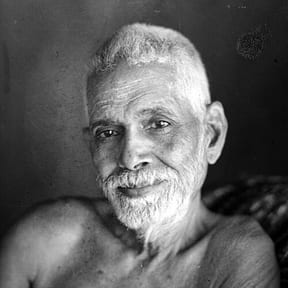
Ramana Maharshi1879–1950
Indischer Weiser, dessen ganze Lehre auf einer Frage beruht: Wer bin ich? Nicht als Rätsel, sondern als Untersuchung, die man tatsächlich durchführt.
Image: G. G. Welling · Public domain · Wikimedia Commons
Nisargadatta Maharaj1897–1981
Bombayer Ladenbesitzer und Lehrer des Advaita. Sein Satz, dass das Erkennen des Selbst keine Errungenschaft ist, sondern ein Aufhören des Suchens, steht hinter mehreren Advaita-Vedanta-Pings.
Meister Eckhartetwa 1260–1328
Dominikaner und Mystiker. Dass in dieser Sammlung ein christlicher Prediger neben Advaita steht, hat einen Grund: seine Beschreibung der Gelassenheit trifft dieselbe Erfahrung mit anderen Worten.



This selection follows the app, not the tradition: these are the people actually named in the deep dives of the Friendly Pings, ordered by how often. Centuries of practice cannot be represented by a handful of names, and that is not the claim here.
What these pings aim at

Pause in the middle of your day — and move on with more clarity
Bring mindfulness into the middle of your life. Just try it.