
Zen
Zen is a school of Mahayana Buddhism that arose in sixth-century China as Chan, out of the encounter with Daoism. It puts practice above doctrine: sitting and ordinary activity count as equals.
- Your Friendly Ping
Today, 07:15
Don't read it. Just do it.
“I do just one ordinary task now — no phone, no music, no hurry.”
Deep DiveMoreZen is not a place we travel to, says the Zen master Hinnerk Polenski; it is a way of meeting life — not only in silence, not only on the cushion, not only when things are easy, but exactly here. The tradition has always insisted on this: samu, work practice, treats sweeping a floor as no lesser than sitting, and the old line about chopping wood and carrying water says the same thing twice. The cost of the alternative is measurable. Switching between tasks carries a real penalty in time and accuracy (Rubinstein, Meyer & Evans, 2001), and Killingsworth and Gilbert (2010), sampling thousands of people at random moments, found that a wandering mind is a less happy mind — whatever the person happened to be doing. That is the honest promise here. Presence does not make the moment extraordinary. It makes it alive.
Ping done - Your Friendly Ping
Today, 09:40
Don't read it. Just do it.
“I put the work down. For this one cup, drinking is all I do.”
Deep DiveMoreA pause that trades one screen for another is not a pause. Attention doesn't recover by being redirected; it recovers by being released. Nathaniel Kleitman, who also discovered REM sleep, found that the brain's roughly 90-minute rhythm does not stop when we wake — it runs on through the day as cycles of rising and falling alertness. Working straight through the trough doesn't extend the peak; it flattens the next one. Zen gives the same instruction more bluntly: when you drink tea, just drink tea. Not tea plus a plan, not tea plus the next message. A cup is small enough to hold the whole of your attention — and that, not its length, is what makes it rest.
Ping done - Your Friendly Ping
Today, 12:30
Don't read it. Just do it.
“I look at something near me as if seeing it for the first time.”
Deep DiveMoreShunryu Suzuki Roshi opens Zen Mind, Beginner's Mind with what became one of the most quoted sentences in Western Zen: 'In the beginner's mind there are many possibilities, but in the expert's mind there are few.' The Japanese shoshin (初心, beginner's mind) describes the quality of attention that has not yet imprisoned what it sees in a category. Neuroscience corroborates this: habituation — the brain's efficiency mechanism — means that familiar objects are literally processed less. The retina actively suppresses redundant signals; the visual cortex fills in what it expects. To look as if for the first time is to override this efficiency with curiosity. Edmund Husserl's phenomenology called the same move epoché: the bracketing of assumption in order to return to the thing itself, as it actually appears.
Ping done
Your day comes back to you
Zen ranks the ordinary and the special equally. Practise that and you lose fewer hours waiting for the right moment.
Less half-doing
Doing one thing while thinking three costs measurable time and accuracy. Zen trains the opposite — and asks for no cushion.
Nothing to attain
The practice has no goal you could miss. That removes a pressure most people no longer notice they carry.
What Zen is
Of all the traditions in this app, Zen is the most sparing with words: not a body of doctrine to memorise, but a stance you rehearse. What is peculiar about it is that it refuses the split between practice and everyday life. Sitting and working rank equally; sweeping a floor is no lesser practice than sitting on a cushion. Hence the line no collection is without: before enlightenment, chop wood, carry water. After enlightenment, chop wood, carry water.
Origins
Zen began in China, not Japan, where Indian Buddhism met Daoism. It travelled to Japan in two waves around 1200, and reached Europe and America only in the twentieth century — first through books, then through teachers who stayed.
Key figures in the Friendly Pings
Notably, the historical figures of Zen shape the tradition but barely appear in this app’s pings. Who stands here is mostly the present.
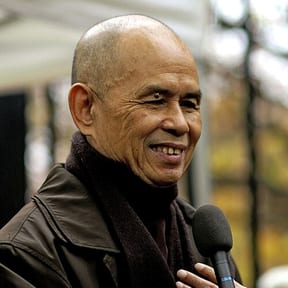
Thich Nhat Hanh1926–2022
Vietnamesischer Zen-Mönch, der Achtsamkeit als Alltagspraxis formulierte statt als Klosterübung: bewusst gehen, bewusst essen, bewusst abwaschen. Von ihm stammt der Ansatz, an dem sich diese App am ehesten orientiert.
Image: Duc (pixiduc) from Paris, France. · CC BY-SA 2.0 · Wikimedia Commons
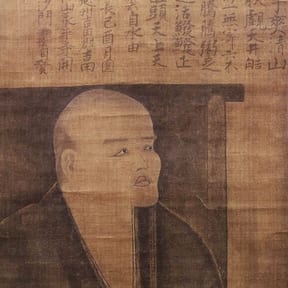
Dōgen1200–1253
Begründer des japanischen Sōtō-Zen. Von ihm stammt Shikantaza, das „nur Sitzen" ohne Ziel und Objekt — und der Gedanke, dass Übung und Erwachen nicht zwei Dinge sind.
Image: Shii · Public domain · Wikimedia Commons
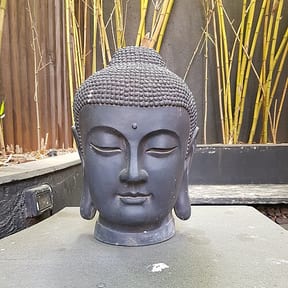
Siddhartha Gautamaetwa 5. Jahrhundert v. Chr.
Der historische Buddha. Im Satipatthana-Sutta ist die Achtsamkeitsübung erstmals systematisch beschrieben, im Achtfachen Pfad ihre Einbettung in eine Lebensführung. Beide Texte stehen hinter einem guten Teil dieser Bibliothek.
Image: Fitindia · CC BY-SA 4.0 · Wikimedia Commons
Shunryu Suzuki1904–1971
Ging 1959 nach San Francisco und baute dort die erste Zen-Gemeinschaft des Westens auf. Sein Satz vom Anfängergeist — dort viele Möglichkeiten, im Geist des Experten wenige — ist der bekannteste Zen-Satz der Moderne.
Hinnerk Polenskigeboren 1961
Deutscher Zen-Meister und Abt des Zen-Klosters Buchenberg. Sein Satz, dass Zen kein Ort ist, den man aufsucht, sondern eine Art, dem Leben zu begegnen, steht im Hintergrund eines der zentralen Pings.
.jpg)

.jpg)
This selection follows the app, not the tradition: these are the people actually named in the deep dives of the Friendly Pings, ordered by how often. Centuries of practice cannot be represented by a handful of names, and that is not the claim here.
What these pings aim at

Pause in the middle of your day — and move on with more clarity
Bring mindfulness into the middle of your life. Just try it.