
Breathwork
Breathwork refers to techniques that guide the breath deliberately in order to influence one’s own state. They range from the Indian practice of pranayama to present-day methods; physiologically it is above all the lengthened out-breath that settles.
A switch you always carry
No device, no app, no preparation. Breathing out longer than in has a settling effect, and you can do it in any situation in which you breathe.
Works where talking fails
An aroused nervous system does not understand arguments. It understands the out-breath — whether or not you believe in the idea.
The fastest way back
The breath happens only in the present. Notice it and you are already there, with no further practice required.
What breathwork is
The breath is a peculiarity: it continues without you, and you can still intervene at any time. No other process in the body is like that. In that double nature lies the reason practically every practice tradition in the world ended up at the breath.
One caution belongs here because popular accounts usually omit it. When you are tense, watching the breath often tightens it — the observation changes the observed. The breath is therefore not the best anchor for everyone or in every situation.
Origins
The oldest developed form comes from India, where the breath was understood not as airflow but as the carrier of life energy. That became a discipline of its own — pranayama — whose techniques have been described in the classical yoga texts for over two thousand years.
The physiological explanation arrived only in the twentieth century. In-breath and out-breath act differently on the autonomic nervous system, which yields the simplest and best-supported instruction in the field: breathe out for longer than you breathe in.
Key figures in the Friendly Pings
The breath pings cite strikingly few names from the breath tradition itself — the voices that appear come mostly from body psychotherapy and research.
Peter Levinegeboren 1942
Begründer von Somatic Experiencing. Sein Ausgangspunkt: Tiere schütteln nach einer Bedrohung buchstäblich ab, was der Körper an Aktivierung hält — Menschen unterbrechen diesen Vorgang meist.
Jill Bolte Taylorgeboren 1959
Neuroanatomin, von der die 90-Sekunden-Regel stammt: Die körperliche Welle einer Emotion ist nach anderthalb Minuten durch — alles darüber hinaus hält der Gedanke daran am Leben.
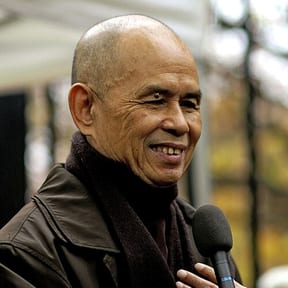
Thich Nhat Hanh1926–2022
Vietnamesischer Zen-Mönch, der Achtsamkeit als Alltagspraxis formulierte statt als Klosterübung: bewusst gehen, bewusst essen, bewusst abwaschen. Von ihm stammt der Ansatz, an dem sich diese App am ehesten orientiert.
Image: Duc (pixiduc) from Paris, France. · CC BY-SA 2.0 · Wikimedia Commons
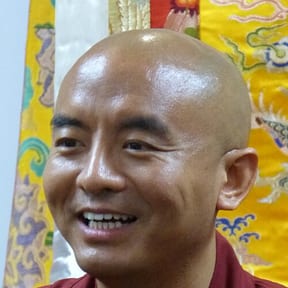
Yongey Mingyur Rinpochegeboren 1975
Tibetischer Lehrer, der offen über seine eigene Panikstörung spricht. Sein Zugang — Unruhe nicht bekämpfen, sondern sie zum Meditationsobjekt machen — steckt in mehreren Pings zu Angst und Körperwahrnehmung.
Image: Gazebo · CC BY-SA 3.0 · Wikimedia Commons
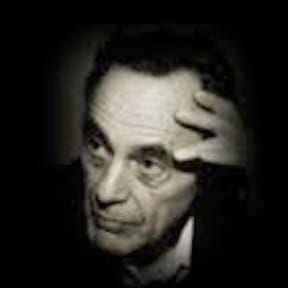
Eugene Gendlin1926–2017
Entwickelte Focusing aus der Beobachtung, dass erfolgreiche Therapieklienten nach einem körperlich spürbaren Sinn tasten — dem felt sense — statt fertige Erklärungen abzurufen.
Image: Aparna sandeep · CC BY-SA 4.0 · Wikimedia Commons
.jpg)


This selection follows the app, not the tradition: these are the people actually named in the deep dives of the Friendly Pings, ordered by how often. Centuries of practice cannot be represented by a handful of names, and that is not the claim here.
What that looks like
The whole text already sits on your lock screen. Tap it and you land here — the deep dives scroll.
- Your Friendly Ping
Today, 07:15
I take one conscious breath. Inhale slow, exhale slower.
Deep DiveThe conscious breath sits at the heart of nearly every contemplative tradition. In yoga's pranayama, the breath carries prana, the life-force; slowing it measurably calms the nervous system. A lengthened exhale activates the parasympathetic system — the branch responsible for rest and recovery. A single conscious breath is enough to step out of autopilot and return to the present.
- Your Friendly Ping
Today, 09:40
My exhale grows long and slow. Breathing out is how I let the day fall away.
Deep DiveThis is the heart of the 4-7-8 breath, popularized by Andrew Weil and drawn from yogic pranayama. The full form: rest the tongue behind the upper teeth, inhale through the nose for a count of four, hold for seven, then exhale audibly through the mouth for eight — repeated for up to four cycles. But the active ingredient is not the counting; it is the ratio. An exhale longer than the inhale engages the parasympathetic branch of the nervous system — the vagal brake that slows the heart with every out-breath (respiratory sinus arrhythmia). Weil calls it a natural tranquilizer for the nervous system: nothing to swallow, always available, and more effective the longer it is practiced. The count is only scaffolding; the long, unhurried exhale is the medicine. Let the out-breath be the place where the day is finally set down.
- Your Friendly Ping
Today, 12:30
When fear rises: I let it pass like a wave — and lengthen my exhale.
Deep DiveA surge of emotion is physiologically self-limiting. Neuroanatomist Jill Bolte Taylor observed that the chemical cascade of an emotion washes through the bloodstream in roughly ninety seconds — what keeps fear burning longer is the thought that re-triggers it. Riding the wave instead of fighting it is the classical Vipassana instruction: observe arising, observe passing. The breath assists mechanically: heart rate falls slightly with every exhale (respiratory sinus arrhythmia), so a deliberately lengthened out-breath engages what Stephen Porges calls the vagal brake. The wave will complete itself either way; the long exhale simply makes the shore arrive sooner.
- Your Friendly Ping
Today, 15:05
I stop for three unhurried breaths. Rest is fuel, not a reward I have to earn.
Deep DiveMicro-break research finds that pauses of even under a minute measurably restore attention and reduce accumulated strain across a workday — recovery is less about duration than about actually disengaging. The body's own scheduling agrees: Nathaniel Kleitman, the pioneer of sleep research, identified a basic rest-activity cycle of roughly ninety minutes that continues through waking hours; pushing through its troughs borrows energy at interest. The older insight is framed differently: cultures that keep a Sabbath understood rest as constitutive of work, woven into its rhythm, not a wage paid afterward. Three unhurried breaths is a Sabbath the size of a moment — and it needs no one's permission.
- Your Friendly Ping
Today, 17:50
Whatever I feel now: I find where it lives in my body, and breathe into it.
Deep DiveEugene Gendlin, a philosopher working alongside Carl Rogers, discovered that lasting insight in therapy depended not on interpretation but on what he called the 'felt sense' — the bodily knowing of a situation, subtler than named emotion and more accurate than thought. His method, Focusing, begins here: finding where a feeling or tension lives in the body, staying with it, letting it speak. Peter Levine's Somatic Experiencing uses the same starting point for trauma resolution: the body knows the shape of the wound, and it is in the body that the resolution happens. The instruction to 'breathe into it' does not describe an anatomical action — it directs attention. What is fully met dissolves; what is avoided persists. Vipassana calls the same practice kāya-anupassanā: body contemplation as the first foundation of mindfulness.
What these pings aim at
Bring mindfulness into the middle of your life. Just try it.
Try it