
Shadow Work
Shadow work goes back to a term from depth psychology: the shadow, the part of oneself one does not want to acknowledge. The practice consists of reading strong reactions to other people as a pointer to it.
- Your Friendly Ping
Today, 07:15
Don't read it. Just do it.
“I find one quality that irritates me in someone — and look for it in myself.”
Deep DiveMoreCarl Jung called the unconscious repository of denied qualities the Shadow — everything in ourselves we have disowned, repressed, or never recognized. His central insight was that what we most strongly reject in others is precisely what we have not yet met in ourselves. Projection — seeing our shadow in another — is a default psychological operation; shadow work is the practice of withdrawing these projections and recognizing their contents as our own. Robert Bly described the shadow as a bag we drag behind us all our lives, stuffing in everything we are told is unacceptable. The irritation we feel at another person's quality is not just a social judgment — it is a signal. The stronger the reaction, the more energy is attached to whatever has not yet been acknowledged in ourselves.
Ping done - Your Friendly Ping
Today, 09:40
Don't read it. Just do it.
“I allow myself to feel lost before I find myself again.”
Deep DiveMoreBeing lost feels like failure. It is more often a passage. Every tradition knows this stretch of road — the dark night of the soul in Christian mysticism, the wilderness of the Hebrew scriptures, the belly of the whale in the old tales — and each describes the same shape: the way forward runs through a place where the old map stops working. Nothing is wrong with you for standing there. Disorientation is simply what it feels like when a self that no longer fits begins to loosen its hold. And notice the quiet promise held in one small word: before. Lost is a station, not a destination. You are not off the path — you are on the stretch of it that has no signposts yet.
Ping done
The intensity is information
Not every criticism lands equally hard. Where the reaction is out of proportion, it is usually not only about the other person.
Less effort spent looking away
What you refuse to see in yourself costs energy continuously. Looking at it is uncomfortable and cheaper afterwards.
Conflicts get smaller
A good share of what escalates between people only half belongs in the room. The other half can be worked on alone.
What shadow work is
The shadow is everything about yourself you refuse to acknowledge: traits that do not fit your self-image, wishes you do not allow, parts trained away early. They do not disappear — they only become invisible, and only to you.
The central observation is practical and easily checked: what irritates us most in others often has to do with something we do not want to see in ourselves. The measure is not the criticism but its intensity.
One limitation belongs here. When it gets serious, this work belongs with a companion and not in a notification. What an app can contribute is the first step: asking the question while standing in the middle of an ordinary day. In this library shadow work is therefore only hinted at — the most thinly represented tradition in the collection, and that is a deliberate reservation rather than an oversight.
Origins
The term comes from the depth psychology of the first half of the twentieth century, developed in contrast to psychoanalysis: the unconscious was held to be not only a store of the repressed but also a source of what consciousness lacks.
One parallel is rarely drawn. Buddhist practice reaches a similar instruction without the term: what arises is not pushed away but looked at — including what you dislike in yourself. Different route, same movement.
Key figures in the Friendly Pings
The deep dive of this group names exactly one person — the one the term comes from.
Carl Gustav Jung1875–1961
Von ihm stammt der Begriff des Schattens: alles an uns selbst, was wir nicht wahrhaben wollen. Seine Beobachtung, dass gerade das an anderen am heftigsten reizt, trägt die Pings zur Schattenarbeit.
Image: (unbekannt) · Public domain · Wikimedia Commons
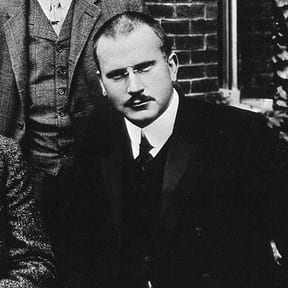

This selection follows the app, not the tradition: these are the people actually named in the deep dives of the Friendly Pings, ordered by how often. Centuries of practice cannot be represented by a handful of names, and that is not the claim here.
What these pings aim at

Pause in the middle of your day — and move on with more clarity
Bring mindfulness into the middle of your life. Just try it.