
Vipassana
Vipassana means insight and denotes a Buddhist form of meditation in which bodily sensations are observed systematically without reacting to them. Its present shape goes back to a renewal movement in early twentieth-century Myanmar.
The urge is only a sensation
What you must do right now — check, avoid, eat — feels compulsory. Staying one breath longer shows that it is not.
Feelings have a place
Nothing arises in the mind without showing up in the body. Find the spot and you have something concrete in front of you instead of a story.
Separating sensing from thinking
Fear presents itself as one solid block. Taken apart into the physical side and the narrative about it, it gets smaller — and each part can be handled on its own.
What vipassana is
Vipassana means insight, more literally clear seeing. It refers to one very specific practice: leading attention systematically through the body and observing what is there — warmth, pressure, tingling, tightness, or nothing at all. Nothing is to be changed.
The core is not the observing but the not-reacting. Because that makes visible what you know in theory and constantly forget in practice: every sensation changes on its own. Two honest notes: in its classical form vipassana is demanding, and close attention to body sensations is not the right practice for everyone at every stage of life.
Origins
The root is one of the oldest meditation instructions in existence, describing four fields of contemplation — body, felt tone, states of mind, and patterns of experience.
As a distinct method it emerged late. In Myanmar in the late nineteenth and early twentieth century a renewal movement opened the practice to lay people and cast it into clearly teachable procedures. From the 1970s a worldwide network of centres grew, offering ten-day silent courses funded entirely by donation.
Key figures in the Friendly Pings
These pings follow the Burmese line almost throughout — plus one voice from addiction research confirming the same observation by other means.
S. N. Goenka1924–2013
Verbreitete die Vipassana-Praxis in der Tradition von Ledi Sayadaw weltweit über zehntägige Schweigekurse. Seine Anweisung, Empfindungen zu beobachten ohne zu reagieren, steckt in fast jedem Vipassana-Ping.
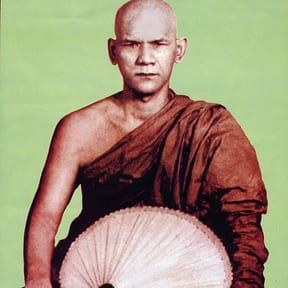
Mahasi Sayadaw1904–1982
Burmesischer Mönch, von dem die Noting-Praxis stammt: das stille Benennen dessen, was gerade auftaucht — „Hören", „Denken", „Enge". Eine der wenigen Übungen, die im Gehen funktionieren.
Image: Unknown authorUnknown author · Public domain · Wikimedia Commons
Judson Brewergeboren 1974
Psychiater und Suchtforscher. Er wies nach, dass Achtsamkeit das Default Mode Network dämpft — jenes Netzwerk, das beim Grübeln und Abschweifen aktiv ist.
Image: Judsonbrewer · CC BY-SA 4.0 · Wikimedia Commons



This selection follows the app, not the tradition: these are the people actually named in the deep dives of the Friendly Pings, ordered by how often. Centuries of practice cannot be represented by a handful of names, and that is not the claim here.
What that looks like
The whole text already sits on your lock screen. Tap it and you land here — the deep dives scroll.
- Your Friendly Ping
Today, 07:15
I sweep my attention slowly from head to feet, once. I fix nothing on the way.
Deep DiveGoenka's ten-day courses spend day after day on a single instruction: move attention through the body, part by part, top to bottom, observing whatever is there — heat, pressure, tingling, nothing at all — and changing none of it. The technique comes down the Burmese line from Ledi Sayadaw to U Ba Khin, and its power lies in what it withholds: no fixing, no relaxing on command, no state the body is supposed to reach. That is also why it restores. Effortful attention — monitoring, correcting, improving — is metabolically expensive, and the sweep replaces it with bare receiving. Body scanning is the element of MBSR most consistently tied to gains in interoceptive awareness, and that people so often grow drowsy during it is not a failure of the practice. It is a nervous system noticing that nothing is being demanded of it.
- Your Friendly Ping
Today, 09:40
When I want to flee, I stay one breath longer — the urge is just a sensation.
Deep DiveThe heart of vipassanā is not seeing pleasant things — it is not reacting to unpleasant ones. Goenka's word for this is equanimity: the sensation is allowed to be there, and the reflex to escape it is watched with the same steady attention as the sensation itself. Courage gets built here, in units far smaller than heroism. Alan Marlatt's relapse-prevention work named the skill urge surfing: urges rise, crest and fall on their own when they are observed rather than obeyed, and every unobeyed urge weakens the pattern that produced it. Judson Brewer's trials found mindfulness training built on exactly this move markedly outperformed the standard smoking-cessation protocol. Avoidance is the engine of fear — it teaches the nervous system that the thing really was unbearable. One more breath teaches the opposite.
- Your Friendly Ping
Today, 12:30
With fear, I split feeling from thinking. Feelings get room — thoughts I let go.
Deep DiveFear presents itself as one solid thing. Vipassanā takes it apart. The classical analysis separates rūpa, the physical event — tight chest, cold hands, fast heart — from nāma, the mental event that narrates what happens next; Mahasi Sayadaw's noting practice makes the split practical, one plain word at a time: tightness, planning, tightness. What survives the separation is striking. The body's half is real but harmless. The mind's half is vivid but not yet true. Matthew Lieberman's affect-labelling studies at UCLA show the mechanism: naming an emotional state in plain words lowers amygdala activity and recruits the right ventrolateral prefrontal cortex — the same move the noting practice has used for centuries. Fear lives in a future that does not exist. The sensation lives now, and it is survivable.
- Your Friendly Ping
Today, 15:05
When joy comes, I find where it sits in my body. Joy has a place.
Deep DiveVipassanā trains attention on vedanā — the felt tone of experience — on the conviction that nothing arises in the mind without arising in the body first. Goenka said it plainly: every mental event comes with a sensation. The instruction is usually turned toward what hurts; turned toward what pleases, it changes the character of joy. Lauri Nummenmaa's bodily maps of emotions (PNAS, 2014) charted the territory literally, and found that people across cultures locate happiness as the most widely embodied of all emotions — chest, head, limbs, nearly the whole silhouette lit up. Joy is not an idea we have about a good moment. It is warmth in the chest and looseness in the face, and it can be felt while it happens — but only if attention arrives while it is still there.
- Your Friendly Ping
Today, 17:50
I pick up my phone and just watch what it stirs in me — then set it down.
Deep DiveBefore the screen even lights up, the pull has already begun — the small itch to check, the flicker of hope about a like, the tightening at the thought of an unread message. The phone is built to stir these currents, and usually they move us before we notice them at all. So try it as an experiment: pick it up and, for a moment, do not obey. Just watch. Notice the wanting, the leaning-in, the faint anxiety or irritation as it arises — the way a meditator watches any sensation come and pass. Seen clearly, an urge loosens its grip; it is a wave, not a command. Then set the phone down. You may find you do not need it for the next hour after all.
What these pings aim at
Bring mindfulness into the middle of your life. Just try it.
Try it