
Eightfold Path
The Eightfold Path is the fourth of the Four Noble Truths and describes the Buddhist path of practice in eight limbs, from right view to right concentration. They are not stages but fields that support one another.
Practice does not stop at sitting
How you speak, how you work, what you live from: all of it counts as practice here. That turns the day into the training ground rather than a break from it.
See rightly first, then act
The order is not accidental. Misjudge the situation and you will act wrongly with great consistency, however hard you try.
Speech is a field of practice
One limb of the path concerns speech alone. Few areas of daily life change so quickly once they get attention.
What the Eightfold Path is
The Eightfold Path is the practical part of the Buddhist diagnosis. What is remarkable is how little of it is meditation. Of eight limbs only three concern what is usually meant by practice; the rest deal with seeing, intention, speech, action and livelihood.
It is not a staircase. The eight limbs are not worked through in order but support one another — hence the wheel as its emblem rather than a ladder. For this app that is exactly the point of connection: a path that includes speaking and working can be practised in the middle of the day.
Origins
The path stands at the beginning of the transmitted teaching, in what tradition holds to be the first discourse ever given, in a deer park near Varanasi in the fifth century BCE. Its form is that of a medical examination — Indian medicine of the time used the same four-part scheme of symptom, cause, curability and treatment.
In the Western mindfulness programmes of the twentieth century the ethical part largely fell away. That was a deliberate decision to make the practice usable in clinics and companies, and it enabled a great deal. It also drew a criticism worth taking seriously: mindfulness without the rest of the path can help someone do more calmly what they would be better off not doing.
Key figures in the Friendly Pings
These pings draw almost entirely on the early transmission, with two teachers who translated it into the present.
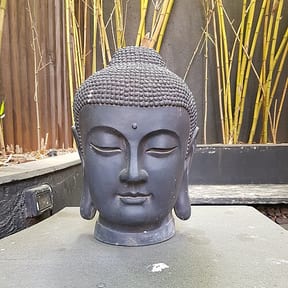
Siddhartha Gautamaetwa 5. Jahrhundert v. Chr.
Der historische Buddha. Im Satipatthana-Sutta ist die Achtsamkeitsübung erstmals systematisch beschrieben, im Achtfachen Pfad ihre Einbettung in eine Lebensführung. Beide Texte stehen hinter einem guten Teil dieser Bibliothek.
Image: Fitindia · CC BY-SA 4.0 · Wikimedia Commons
S. N. Goenka1924–2013
Verbreitete die Vipassana-Praxis in der Tradition von Ledi Sayadaw weltweit über zehntägige Schweigekurse. Seine Anweisung, Empfindungen zu beobachten ohne zu reagieren, steckt in fast jedem Vipassana-Ping.
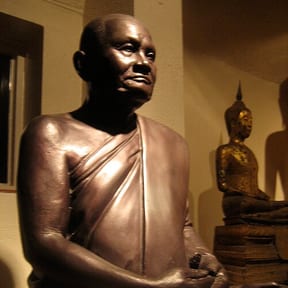
Ajahn Chah1918–1992
Thailändischer Waldmönch und Lehrer vieler westlicher Schüler. Sein Ton — trocken, bildhaft, unsentimental — hat den westlichen Theravada geprägt.
Image: Akuppa John Wigham from Newcastle upon Tyne, England · CC BY 2.0 · Wikimedia Commons
.jpg)
.jpg)
This selection follows the app, not the tradition: these are the people actually named in the deep dives of the Friendly Pings, ordered by how often. Centuries of practice cannot be represented by a handful of names, and that is not the claim here.
What that looks like
The whole text already sits on your lock screen. Tap it and you land here — the deep dives scroll.
- Your Friendly Ping
Today, 07:15
Before speaking next: I ask — is it true, and is it beneficial?
Deep DiveThe Majjhima Nikāya gives the Buddha's five criteria for Right Speech (sammā vācā): the words are spoken at the right time, they are true, they are gentle, they are beneficial, and they come from a mind of goodwill. This is not a checklist but a quality of presence before speaking. 'Is it true?' is necessary but not sufficient — harmful truths spoken at the wrong moment are still failures of Right Speech. 'Is it beneficial?' (Pali: hitāya) asks: who benefits, and how? — including the speaker, the listener, and the broader situation. The practice of asking these questions before speaking is itself a form of sammā sati (right mindfulness): a pause in which the mouth waits for clarity. Most regretted words were spoken without it.
- Your Friendly Ping
Today, 09:40
I choose the path that causes least harm to anyone here.
Deep DiveAhiṃsā (non-harming) is among the oldest ethical precepts in Indian philosophy — it appears as the first of Patanjali's yamas (ethical restraints) in the Yoga Sutras, and is the defining ethical principle of Jainism. In the Buddhist Eightfold Path, avihiṃsā (non-violence in intention) is the third component of Right Intention alongside renunciation and non-ill-will. Gandhi translated ahiṃsā not merely as abstaining from violence but as the active force of love — a creative, generative principle. The question 'what causes least harm?' is not a utilitarian calculation alone — it is a reorientation of motivation: am I acting from genuine care for what is in front of me, or from habit, fear, or self-protection? Least harm is not the absence of action. It is the most honest action available.
- Your Friendly Ping
Today, 12:30
I acknowledge the discomfort that's actually here — I don't look away from it.
Deep DiveThis is the first of the Buddha's Four Noble Truths: the truth of suffering (dukkha). It is not pessimism but a clear diagnosis — the honest acknowledgment that unease, dissatisfaction, and pain are part of life. Only by looking at the discomfort, rather than fleeing it, can its origin be understood. The looking itself is already the first step on the path that leads out of suffering.
- Your Friendly Ping
Today, 15:05
I find one wholesome thing to nourish — and one unwholesome to stop feeding.
Deep DiveSammā vāyāma (Right Effort) is described in the Pali Canon as a complete decision tree with four aspects: preventing unwholesome states from arising, abandoning those that have arisen, cultivating wholesome states, and maintaining those already present. Whatever state you find yourself in, one of the four applies — the practice never comes up empty. This ping works the two aspects for states already here: what is unwholesome is abandoned not by fighting it but by withdrawing its fuel — attention, rumination, the inner retelling. And what is wholesome is a seed, not a finished flower: it can be protected by declining to trade it immediately for stimulation, by continuing the quiet a few moments longer, by noticing that something good is present and choosing not to spend it.
- Your Friendly Ping
Today, 17:50
I look for one thing I'm craving right now — and loosen my grip on it.
Deep DiveNekkhamma — renunciation — is the first component of Right Intention (sammā sankappa) in the Eightfold Path and one of the ten pāramīs (perfections) traditionally cultivated on the path to awakening. It is easily misunderstood as deprivation. Ajahn Chah described it more accurately: 'Renunciation is not giving up the things of this world. It is accepting that they pass.' The practice is not to eliminate wanting but to loosen the compulsive grip that transforms preference into demand. The Pali word taṇhā, usually translated as 'craving,' literally means 'thirst' — it describes not wanting per se but the clinging quality that surrounds it. What remains when the grip loosens is often the thing itself, without the anxiety.
What these pings aim at
Bring mindfulness into the middle of your life. Just try it.
Try it